Beaverton Yard Debris Removal Cost Guide: What You’ll Actually Pay
Yard debris removal in Beaverton, OR, costs between $99 and $900+, depending on load volume and debris type. Small cleanups — a pile of branches or seasonal leaves — start at $99. Large jobs like storm cleanup or full yard renovation run $600 and up. Free written estimates are available from licensed local haulers.

We get calls like this pretty regularly—someone in Bethany or Raleigh Hills who let yard debris pile up through the winter, figured they’d handle it themselves, and then spring arrived and suddenly there’s a 6-foot brush pile, two rounds of storm branches, and a dead shrub they’ve been meaning to pull since October. The WM cart won’t touch it. A rental truck feels like overkill. And calling three different companies for estimates sounds exhausting.
That’s exactly the situation where understanding the yard debris removal cost in Beaverton before you start calling around can save time, money, and a lot of frustration. Having real local pricing in front of you makes the decision much easier.
In Washington County, most residential yard debris pickups cost between $99 and $450. Larger loads — full landscaping cleanouts, storm debris, or sod removal — run $450–$900+. Pricing is based on truck space used, debris type, and weight. All organic waste goes to Washington County composting facilities — not a landfill. Free written estimates are available with no obligation.
What Does Yard Debris Removal Cost in Beaverton, OR?
Most websites skip this part: yard debris removal isn’t priced by the hour or by the bag. You pay for the space your debris takes up in a licensed hauling truck. That’s it. A small pile of autumn leaves from an Aloha townhouse costs far less than a full yard renovation cleanup in Cedar Hills — even if both jobs take the same crew the same amount of time.
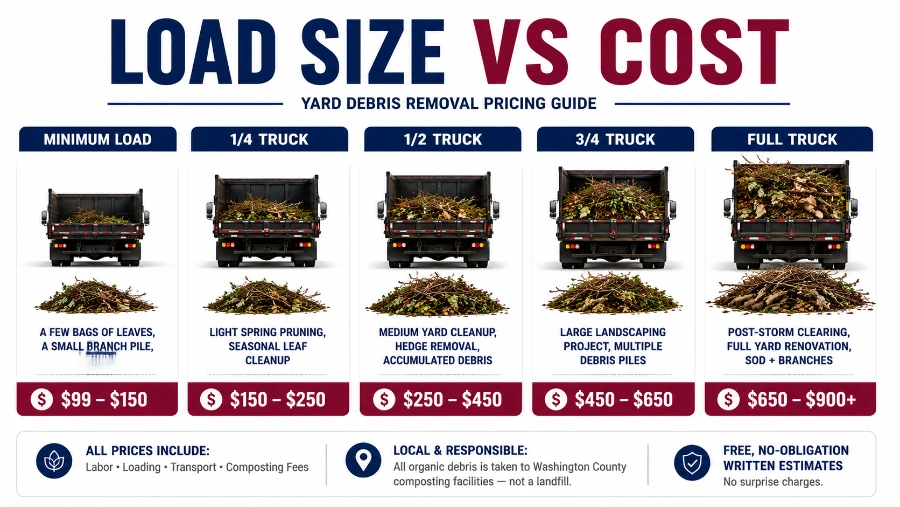
Here’s what homeowners are actually paying right now:
| Load Size | What It Typically Covers | Estimated Cost |
|---|---|---|
| Minimum Load | A few bags of leaves, a small branch pile, 1 shrub | $99–$150 |
| 1/4 Truck | Light spring pruning, seasonal leaf cleanup | $150–$250 |
| 1/2 Truck | Medium yard cleanup, hedge removal, accumulated debris | $250–$450 |
| 3/4 Truck | Large landscaping project, multiple debris piles | $450–$650 |
| Full Truck | Post-storm clearing, full yard renovation, sod + branches | $650–$900+ |
All prices include labor, loading, transport, and Washington County composting fees. No surprise charges after the job.
Now, the part that surprises most people: two neighbors on the same street in Five Oaks can have what looks like the same pile of debris — but one quote comes in higher because the debris is waterlogged from the Oregon rain, which adds real weight, and composting facilities charge by the ton. Volume and weight aren’t the same thing. More on that below.
Not sure where your job falls? Use our free cost calculator before you call—it takes 60 seconds and gives you a realistic range.
Yard Debris Removal Cost by Debris Type
This is where things usually get confusing. Most people assume yard waste is yard waste—price it all the same, load it all the same, and they’re done. It doesn’t work that way. Leaves, branches, sod, and storm debris each land in a completely different cost range because they weigh differently, take up truck space differently, and get processed differently at Washington County composting facilities.

Leaves and Grass Clippings — Starting at $99
Lightest on the truck, lightest on your wallet. Most leaf and grass cleanups in the city fall in the $99–$200 range — even when the volume looks intimidating in a pile.
The Cedar Hills and Bethany neighborhoods hit especially hard in fall. Those mature Douglas firs and big-leaf maples drop more than a standard 60-gallon WM cart can handle week after week. By November, most homeowners are looking at two to three months of accumulated leaf volume that needs a single professional pickup to clear.
One thing: don’t bag it. Loose debris loads faster. Bagging takes your time, slows our loading, and adds zero value for you. Just stage the pile somewhere accessible.
Branches and Brush — $99 to $400
Branches and brush take up significantly more truck space than loose leaves, which moves the price up. A small pile of pruning branches—a hedge trimmed back or an ornamental tree cleaned up—typically runs $99–$175. A bigger project, like clearing a brush line along a fence in Raleigh Hills or hauling multiple seasons of overgrown shrub growth, can reach $200–$400 depending on total volume.
Companies offering brush and branch removal estimates in Beaverton—including our team—provide free written quotes before anything is loaded. Call (971) 297-3939 for same-day availability across Washington County.
Sod and Dirt — $200 to $500+
Sod and dirt removal typically costs $200–$500 depending on square footage and whether the soil contains non-organic material like gravel or landscape fabric. It’s the most expensive yard-debris type—not because of volume but because of weight.
Washington County composting facilities charge by the ton for heavy organic material, and sod is dense. A small pile that looks manageable on a Bethany lawn in February can weigh several hundred pounds once it’s wet. Mixed loads — sod combined with gravel or concrete debris — cost more because they can’t go straight to composting and require separate handling.
If your job involves sod removal alongside other debris, mention it when you call. It affects the estimate significantly.
Storm Debris — $400 to $900+
Western Oregon doesn’t mess around with winter storms. Between November and March, Beaverton, Bethany, Five Oaks, and Raleigh Hills properties regularly take on broken branches, downed limbs, scattered landscaping material, and the occasional fence section that didn’t survive the wind. That mix of debris almost always fills a 3/4 to full truck.
Storm debris removal typically runs $400–$900+, depending on volume and access. Post-storm scheduling fills fast. If you need same-day pickup after a storm event, call before noon—see our same-day junk removal page for availability.
Landscaping and Renovation Debris — $300 to $700+
Post-renovation cleanup — after a contractor finishes, after a landscape overhaul, after pulling up old garden beds — generates some of the largest yard debris volumes. These jobs often mix organic material with non-organic items: old edging, landscape fabric, wooden posts, and gravel.
Organic-only loads go straight to Washington County composting. Mixed loads require sorting, which adds time and adjusts the quote. A typical mid-sized landscaping cleanout in Beaverton runs $300–$700+ depending on the mix. If you’ve got bulky non-organic items alongside the yard debris, see our large item removal page.
What’s the cheapest way to get rid of yard waste in the local area?
For ongoing light yard waste, the WM yard debris cart add-on is the lowest-cost option at $8.20/month (City of Beaverton, effective October 2025 per WM Northwest). For large accumulated volumes, professional pickup avoids the cost of truck rental, fuel, and multiple transfer station trips. For a single large load where you already own a truck, a DIY Metro South run is viable — review the prep requirements before you go.
What Factors Actually Influence Your Yard Debris Removal Price?
And honestly, this is where most mistakes happen—people get a quote that seems higher than expected, and they don’t understand why. These are the yard-debris-specific cost drivers, separate from general junk removal pricing.
(For a full breakdown of general junk removal pricing factors, see: what affects junk removal pricing in Beaverton)
Beaverton Cost Guide — junkremovalbeavertonor.com
What Actually Affects
Yard Debris Removal Cost?
Most homeowners focus on pile size. But five different factors determine your final quote.
More volume requires more truck space and labor.
Grass Clippings
Plant Trimmings
Dirt
Storm Debris
Some materials are significantly heavier and more expensive to process.
Rain-soaked debris can weigh several times more than dry material.
Long Carry Distance
Steep Access
Hard-to-reach debris increases labor time.
Post-Storm Cleanup
Demand spikes during cleanup seasons.
Volume and Truck Space
Primary driver. The more truck space your debris fills, the higher the price. The tricky part is that loose debris expands when loaded—a pile that looks like a quarter-truck on your Aloha driveway often fills a half-truck once it’s on it.
Practical tip: Gather everything into one visible pile before we arrive. Scattered debris across a Five Oaks backyard is harder to estimate accurately than a consolidated staging area near the street.
Wet vs. Dry Weight
This one matters more in Washington County than almost anywhere else in the country. Beaverton’s rainy season runs October through April — and wet leaves weigh three to four times more than dry ones. Waterlogged branches, rain-soaked sod, saturated grass clippings—all of it adds real tonnage at the composting facility.
If your debris has been sitting through the Oregon rain for a few weeks, expect the quote to reflect higher weight-based disposal fees. Timing your cleanup for a dry stretch in late spring or early summer is the simplest way to keep the price lower—though honestly, most people just want it gone.
Debris Composition
Oregon DEQ guidelines require yard debris entering Washington County composting to be free of non-organic contamination — no rocks, no plastic bags, no metal stakes, and no concrete mixed with soil. Contaminated loads can’t go to composting and get reclassified as general waste, which costs more.
This comes up a lot with Five Oaks and Raleigh Hills homeowners cleaning up after landscaping projects, where it’s common to have organic debris mixed with gravel, old landscape edging, or treated wood pieces. Separating that before we arrive saves you money.
Property Access
Standard driveway access in central Beaverton (97005–97007) and Aloha adds nothing to the quote. But properties with gated backyards, steep hillside lots in Raleigh Hills and Bethany, or debris staged at the far end of a long lot require extra loading time—which may add a modest labor charge.
If you can move debris to your front yard or driveway before we arrive, do it. That one step is the most effective way to keep your quote down.
Seasonal Demand
Spring cleanup season (March through May) is the busiest period for yard debris removal across Washington County. Storm cleanup in winter follows the same pattern. If you need urgent removal after a storm hits Cedar Hills or Five Oaks, calling early in the day gives you the best shot at same-day dispatch.
Mid-summer and mid-winter between storms offer the fastest scheduling and most flexible windows.
Oregon Composting Facility Fees
Every load we haul goes to a licensed Washington County composting or green waste processing facility — not a landfill. Those facilities charge tipping fees by material type and weight, and those fees are built into your written estimate. You won’t see a surprise “disposal surcharge” appear after we’re done.
If you’re weighing a DIY run to the Metro South Transfer Station in Oregon City instead, read our guide on common Metro South mistakes Beaverton residents make first. There are load prep requirements that catch people off guard and lead to rejected loads, unexpected fees, and wasted trips.
Where can I find yard debris removal services with good reviews near Beaverton?
Search Google Maps for “yard debris removal Beaverton OR” and filter by rating. Look for Oregon-licensed companies with verified insurance and reviews mentioning specific neighborhoods. Beaverton Junk Removal holds a 4.9/5 rating across 500+ Washington County customers. The BBB and Yelp also carry independently verified reviews of local haulers.
Cheapest Ways to Remove Yard Waste — Honest Comparison
The honest answer: there’s no single cheapest option for every situation. The right choice depends on how much debris you have, whether you own a truck, and what your time is actually worth.
| Method | Best For | Estimated Cost | The Real Catch |
|---|---|---|---|
| WM Curbside Yard Debris Cart | Ongoing light yard waste — bags of leaves, weekly clippings | $8.20/month add-on (Beaverton, effective Oct 2025, per WM Northwest) | 60-gal cart only · biweekly pickup · no large branches · no bulk volumes · no storm debris |
| DIY — Metro South Transfer Station | Single large load if you own a truck and have time | Weight-based tipping fee + fuel + labor | Must sort and prep load · drive to Oregon City · load and unload yourself · rejected if contaminated |
| Professional Removal | Large accumulated volumes · storm debris · no truck · no time | $99–$900+, depending on load | Higher upfront than the WM cart for light weekly waste |
The WM Northwest yard debris cart at $8.20/month makes sense for routine maintenance — weekly grass clippings and small leaf accumulations that fit a 60-gallon bin. The moment you have more than a few weeks of accumulated debris, a storm event, or any volume that exceeds cart capacity, professional removal becomes the more practical — and usually the more cost-effective — option when you factor in truck rental, fuel, transfer station fees, load prep time, and multiple trips.
How to Deal With Large Amounts of Debris
Sometimes the pile just gets away from you. Post-storm. Post-renovation. An overgrown property you inherited. Months of missed WM pickups after a busy stretch. Whatever the reason, here’s the most efficient path forward.
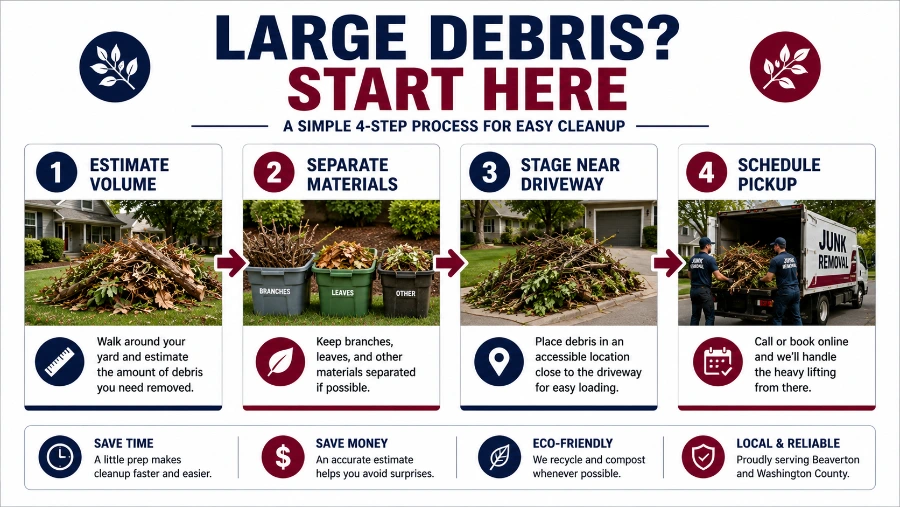
1. Estimate your volume. Walk your yard and match what you see to the load size table above. Most people underestimate a pile that looks manageable on the ground; it often fills a half to three-quarter truck once it’s loaded loose.
2. Separate organic from non-organic. Pull out rocks, old landscape fabric, metal stakes, treated wood, and any plastic. Keeping your pile organic-only speeds up pickup and keeps your quote lower.
3. Stage everything in one accessible area. Move debris to your front yard or driveway if possible. This matters especially for Bethany and Raleigh Hills properties, where debris can be spread across hillside lots or behind gated backyards.
4. Don’t bag it. Loose debris loads faster and cheaper. Skip the bags entirely.
5. Call for a free written estimate. We serve all Beaverton ZIP codes—97005, 97006, 97007, 97008, 97225, and 97229, including Aloha, Five Oaks, Cedar Hills, Raleigh Hills, and Bethany. Same-day and next-day slots are available. Most large residential yard debris jobs are done in a single visit. → yard debris removal
Do I Need to Bag Yard Debris Before Pickup?
No — loose debris loads directly onto the truck. No bagging required.
Just stage everything in one accessible area before we arrive. Bagging actually works against you: it takes your time, slows our loading, and doesn’t reduce your cost by a single dollar. A loose pile of branches or leaves from your Cedar Hills or Aloha yard loads faster—and faster loading keeps your quote as low as possible.
What Yard Debris Do Beaverton Removal Services Accept?
Before you call, it helps to know what’s in and what’s out—so there are no surprises when the crew arrives.
| ✅ Accepted | ❌ Not Accepted / Quoted Separately |
|---|---|
| Branches and limbs (any size) | Tree stumps (quoted separately) |
| Leaves and grass clippings (loose) | Soil mixed with concrete or gravel |
| Shrubs, hedges, and root balls | Treated, painted, or stained wood |
| Sod (weight-based quote) | Hazardous or chemically treated plant material |
| Storm debris—branches, broken limbs | Large rocks or masonry mixed into debris |
| Garden waste and plant trimmings | Asbestos-containing materials |
Oregon DEQ requires yard debris entering Washington County composting to be free of non-organic contamination. Our crew sorts during loading to keep your waste on the right disposal path—something you’d have to handle yourself before a Metro South transfer station run.
Can Junk Removal Companies Take Branches, Leaves, and Storm Debris in Beaverton?
Yes—branches, leaves, grass clippings, brush, and storm debris are all standard items for licensed junk services in Beaverton. You don’t need a landscaping company.
A professional hauling crew loads everything directly from your property — loose, unbagged, and without any prep work on your end — and transports it to Washington County composting facilities. This includes post-storm branch piles, seasonal leaf accumulations, overgrown brush, and mixed yard cleanup debris from Bethany, Five Oaks, Raleigh Hills, and Aloha properties.
Where Does Yard Debris Go After Pickup?
Every load we collect — from Cedar Hills to Aloha, from Bethany to Five Oaks — goes to a licensed Washington County composting or green waste processing facility. Not a landfill.
- Branches and limbs → chipped into wood mulch at certified Oregon facilities
- Leaves and grass → composted into soil amendment
- Sod → processed at organic composting facilities under Oregon DEQ guidelines
- Mixed organic debris → sorted at Washington County facilities; organic and non-organic streams separated on arrival
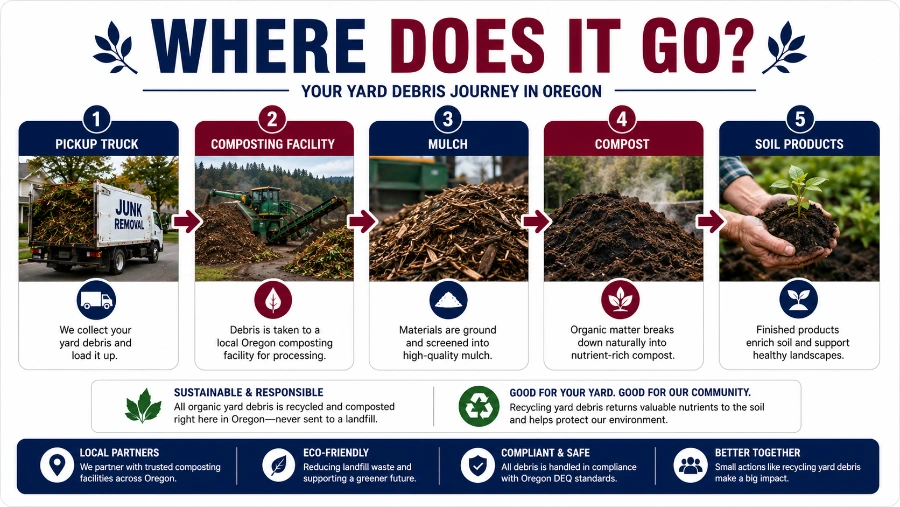
Oregon Metro’s yard debris composting program keeps thousands of tons of organic material out of regional landfills each year, and every load we haul feeds directly into that system. Unlike some national app-based platforms operating in the area, we use Oregon-permitted facilities and can provide disposal documentation if needed for property managers, real estate transactions, or estate cleanouts.
For a full breakdown of how all junk types are handled after pickup, see where does junk go after removal in Beaverton.
Frequently Asked Questions — Yard Debris Removal Cost in Beaverton
Most residential yard debris pickups across the city cost $99–$450. Large-volume loads — full landscaping overhauls, sod removal, or post-storm cleanups — run $450–$900+. All quotes include labor, loading, transport, and Washington County composting fees. No hidden charges after the job.
Five things drive the price: load volume (truck space used), debris weight (wet Oregon debris weighs significantly more than dry), debris type (sod costs more than leaves), property access (hillside or gated lots in Raleigh Hills and Bethany take longer to load), and debris composition (contaminated loads can’t go to composting). Of these, volume and weight have the biggest impact on your final quote.
Yes. Beaverton Junk Removal provides free written estimates for all yard debris jobs across Washington County—Aloha, Cedar Hills, Five Oaks, Raleigh Hills, Bethany, and central Beaverton. Call (971) 297-3939 or use the online cost calculator. No commitment required.
Sod and dirt are priced by weight, not volume — they’re the heaviest yard debris type. A typical sod project in Beaverton runs $200–$500 depending on square footage and whether the soil contains non-organic material. Contact us for a written estimate before committing to any sod or soil project.
Don’t try to overfill the bin—WM drivers will skip overfull carts. Stage the overflow in your yard and schedule a professional pickup. Most large yard debris jobs are completed in a single visit, the same day or the next day.
Ready to Get a Real Price on Your Yard Cleanup?
If you’re comparing yard debris removal costs in Beaverton, the fastest way to get an accurate price is with a free written estimate. Whether you’ve got branches piled up after a Bethany storm, a Cedar Hills yard renovation that needs clearing before a sale, or accumulated debris that your WM cart can’t handle, we can usually get there the same day or the next day.
📞 Call (971) 297-3939 — Monday–Saturday, 6 AM–8 PM
🧮 Or try the free cost calculator first
We serve ZIP codes 97005, 97006, 97007, 97008, 97225, and 97229 — including Aloha, Cedar Hills, Five Oaks, Raleigh Hills, Bethany, and all of Washington County.
Related reading:
Yard Debris Load Estimator
3 quick steps — estimate your load size and price.