Appliance Removal in Beaverton, OR: Complete Disposal & Cost Guide
Appliance removal in Beaverton isn’t as simple as putting it out with regular trash. Depending on the large household item, you can recycle it, donate it if it still works, use a retailer haul-away program, self-haul it to a transfer station, or schedule pickup.
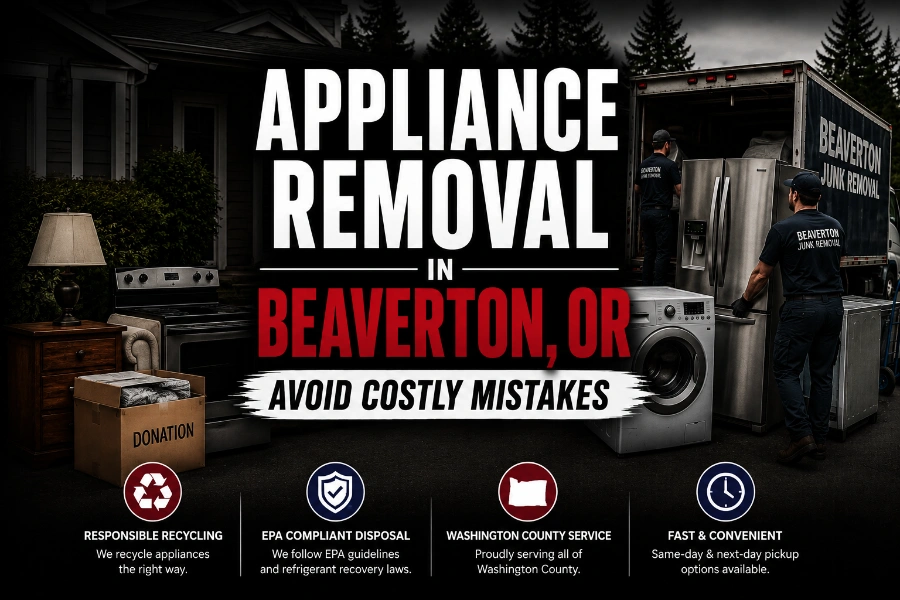
A homeowner near Cedar Hills pulls the old refrigerator out during a kitchen remodel, only to realize appliance removal in Beaverton isn’t as simple as curbside pickup, the driveway isn’t the place to leave it for long, and nobody explained what “certified refrigerant recovery” actually means. That’s the exact moment this guide is for.
In Beaverton, old appliances are handled through one of five paths: recycling through a certified recycler or scrap processor, donation if they still work, retailer haul-away when you buy a replacement, self-haul to a Metro transfer station, or professional Junk removal pickup. Refrigerators, freezers, and air conditioners need their refrigerant recovered by a certified technician before they can be legally processed; that’s the one rule that shapes almost every other decision in this guide.
Can You Just Throw an Appliance in the Trash
No, in most cases, you cannot put major items out with your regular household trash in Beaverton. Large household items fall outside standard curbside garbage service, and refrigerators, freezers, and similar equipment are also subject to federal rules around refrigerant recovery that a regular trash pickup isn’t set up to handle.
Why Large Household Items Are Treated Differently
These aren’t just bulky; many contain materials that need to be separated and handled correctly: refrigerant gases in the cooling unit, oils in compressors, and recyclable metal, plastic, and glass that constitute the bulk of the unit. Oregon treats large households as a category that should be recycled rather than landfilled, which is why haulers, scrap processors, and junk removal companies handle them differently than a bag of household trash. You can review Oregon’s broader recycling framework directly on the Oregon DEQ recycling laws page.
What are the consequences of illegally dumping one
Leaving it at the curb without an approved pickup, or dumping it on undeveloped land, roadside, or in a dumpster you don’t have permission to use, can result in fines and cleanup costs, and if it’s a refrigerator or freezer, improperly discarding it also risks releasing refrigerant into the air, which is a separate federal violation. It’s a bigger hassle than any of the five legitimate disposal paths below.
The 5 Ways to Get Rid of an Old Appliance in Beaverton
Before you decide who to call or whether to call anyone at all, it helps to know the actual menu of options for appliance removal in Beaverton. Not all equipment belongs on the same path, and picking the wrong one usually means wasted time or an unnecessary fee. Here’s how the five realistic paths compare.
Recycling (Scrap Metal / Certified Recyclers)
Most major equipment is made mostly of recyclable steel, aluminum, and copper, which is why certified recyclers and scrap processors accept them. This is often the right path once equipment is broken or no longer usable. Our metal recycling service handles this end of the process.
Donation (Working Appliances)
If it still works and is reasonably clean, donation is often the best option; it keeps a usable item out of the waste stream entirely and can help a neighbor or local family. Not every donation center accepts every type, so it’s worth confirming before you haul it over. If you’re weighing donation against a paid pickup, our guide on donating furniture or hiring junk removal covers the same trade-offs in more detail.
Retailer Haul-Away (Home Depot, Lowe’s, Best Buy)
When you buy a new one, some retailers will remove your old one as part of delivery. This is often the most convenient option if you’re already replacing the unit, though it usually depends on purchasing a new appliance and isn’t available for every product category. (See the retailer breakdown further down in this guide.)
Junk Removal Pickup
Professional junk removal is the most convenient option when a unit is broken, heavy, awkward to move, or you simply don’t want to deal with hauling and drop-off logistics yourself; the crew handles the lifting, transport, and proper appliance disposal or recycling. This overlaps with our large item removal services for anything too big or heavy to move safely on your own.
Self-Haul to a Transfer Station
If you have a truck and don’t mind the trip, these can be dropped off directly at a Metro-area transfer station. Both Metro Central in Portland and Metro South in Oregon City accept large ones, with coolant-containing units accepted for an added fee. This is usually the cheapest option in terms of pure disposal cost, but it comes with the labor of loading, transporting, and unloading a heavy appliance yourself. For more on what to expect at drop-off, see our guide on avoiding mistakes at Metro South.
Comparison: Which Option Wins on What
| Option | Cheapest | Fastest | Most Convenient | Best For |
|---|---|---|---|---|
| Recycling (scrap/certified recycler) | Yes | — | — | Non-working with no donation value |
| Donation | Yes | — | — | Working in good condition |
| Retailer Haul-Away | — | Yes | Yes (if buying new) | Anyone replacing the appliance at purchase |
| Junk Removal Pickup | — | Yes | Yes | Heavy, broken, or hard-to-move |
| Self-Haul to Transfer Station | Yes | — | — | People with a truck and time to spare |
Can Junk Removal Take Refrigerators?
Yes. Professional junk removal services can take refrigerators and freezers, but the refrigerant has to be recovered by a certified technician before the unit is scrapped or recycled. A legitimate junk removal company handles that as part of the process.
Which Option Is Best for Your Appliance? (Decision Framework)
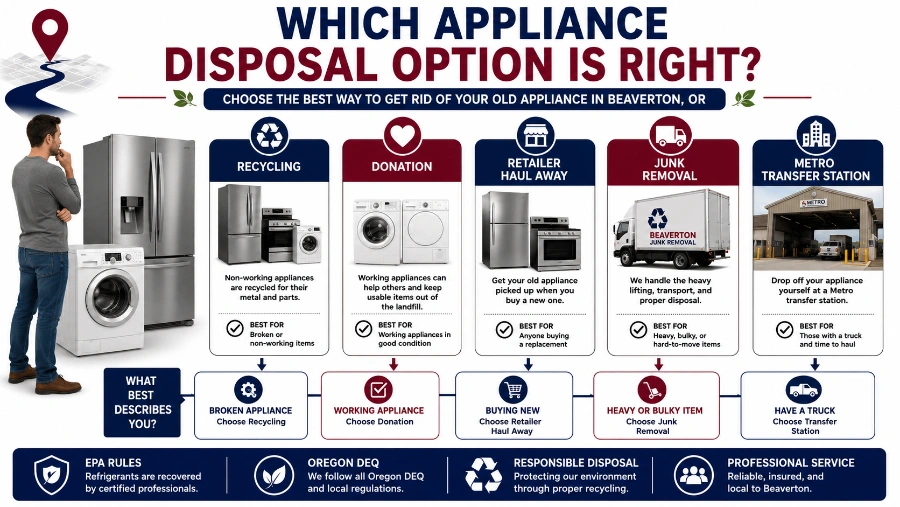
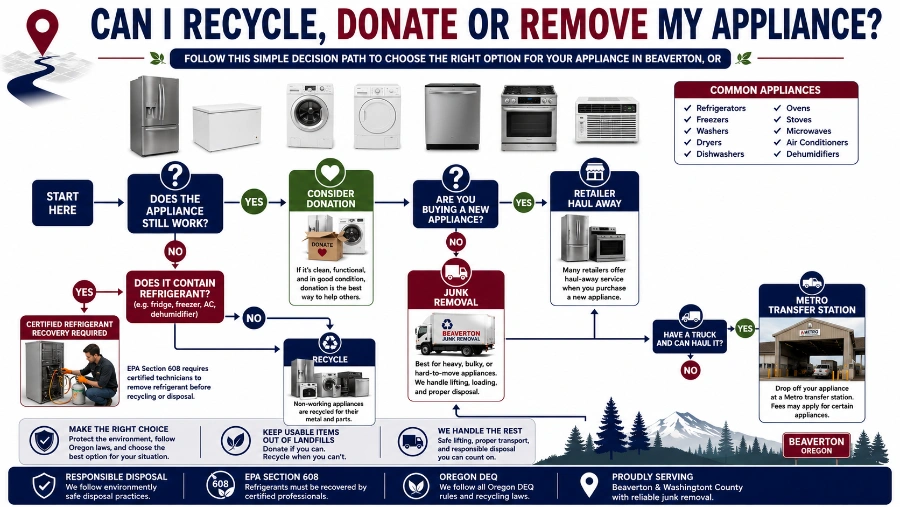
The fastest way to choose is to answer two questions: does it still work, and does it contain refrigerant? The two sections below walk through why each question matters; the visual after them condenses both into a quick reference.
Working vs. Broken
If it still runs and is in reasonably good condition, donation or retailer trade-in is worth checking first; they get the most value out of an item that still has life left in it. If it’s broken, damaged, or simply outdated beyond donation standards, recycling or junk removal is the more realistic path.
Refrigerators/Freezers vs. Washers/Dryers/Ovens
Refrigerators, freezers, and window air conditioners all contain refrigerant, which means they need certified handling no matter which path you choose. Washers, dryers, dishwashers, ovens, and stoves don’t have that requirement, which generally makes them simpler and sometimes cheaper to move through any of the five paths.
Refrigerators, Freezers & Refrigerants: What the Law Requires
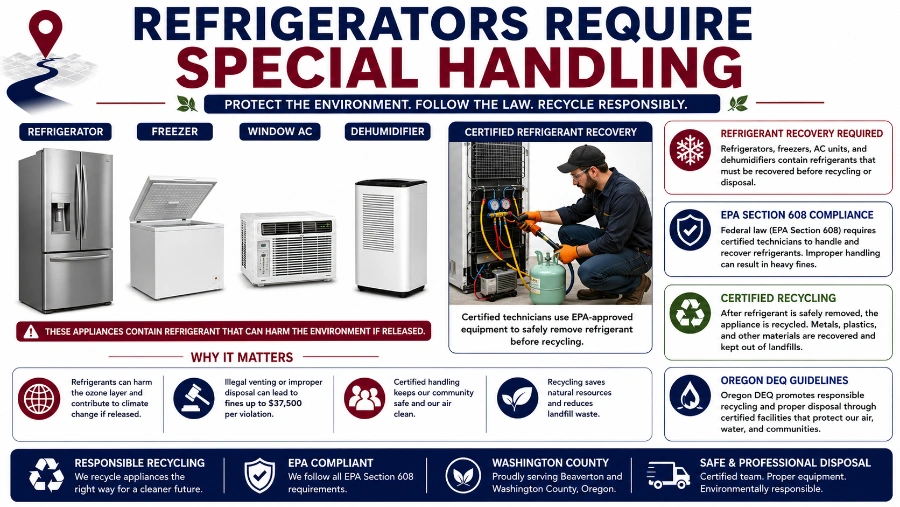
Refrigerators, freezers, and similar cooling items are the one category where “just take it to the scrap yard” isn’t the whole story; federal law requires the refrigerant to come out safely first.
EPA Refrigerant Recovery Rules
Under the federal Clean Air Act, refrigerant has to be recovered from refrigeration and air-conditioning equipment according to EPA’s servicing requirements before the equipment is disposed of. For household refrigerators, freezers, and similar units and appliances that typically still have their refrigerant charge intact when they’re discarded, the final party in the disposal chain, such as a scrap metal recycler, is responsible for making sure that refrigerant recovery happens before the unit is processed for scrap. In practice, this is usually documented with a signed statement identifying who recovered the refrigerant and when.
Oregon DEQ Guidance on Recycling
Oregon’s recycling framework is built on the Opportunity to Recycle Act (Oregon Revised Statute 459A), which requires cities and counties to provide recycling programs and sets statewide material recovery goals. The Oregon Department of Environmental Quality oversees how that plays out locally, including for large households. If you’re dealing with a large volume, for example, a property management or estate cleanout situation, DEQ’s website is worth checking directly for current program specifics in Washington County.
Which Equipment Can Be Recycled
Almost every major household can be recycled in some form. The differences come down to what kind of handling each one needs first.
Refrigerators & Freezers
Recyclable, but only after certified refrigerant recovery. Once that’s done, the metal, plastic, and glass components are broken down and processed like standard scrap.
Washers & Dryers
Straightforward to recycle, no refrigerant involved. Most of a washer’s or dryer’s weight is recyclable steel, which is part of why they’re usually simpler (and often cheaper) to process than refrigerator recycling.
Dishwashers
Recyclable in the same way as washers and dryers, mostly metal construction with no refrigerant to worry about.
Ovens & Stoves
Recyclable, with gas models sometimes requiring a quick check that fuel lines are properly disconnected before pickup or drop-off.
Microwaves
Technically an appliance, but small enough that some recyclers handle them more like electronics than large ones, it’s worth checking whether it fits under an appliance pickup program or our electronics recycling service locally.
Can I Recycle a Microwave?
Yes, though microwaves are often processed more like electronics than large equipment because of their smaller size and circuit boards. Check whether your recycler handles them under an appliance or electronics program before dropping one off.
Accepted vs. Not Accepted — Disposal at a Glance
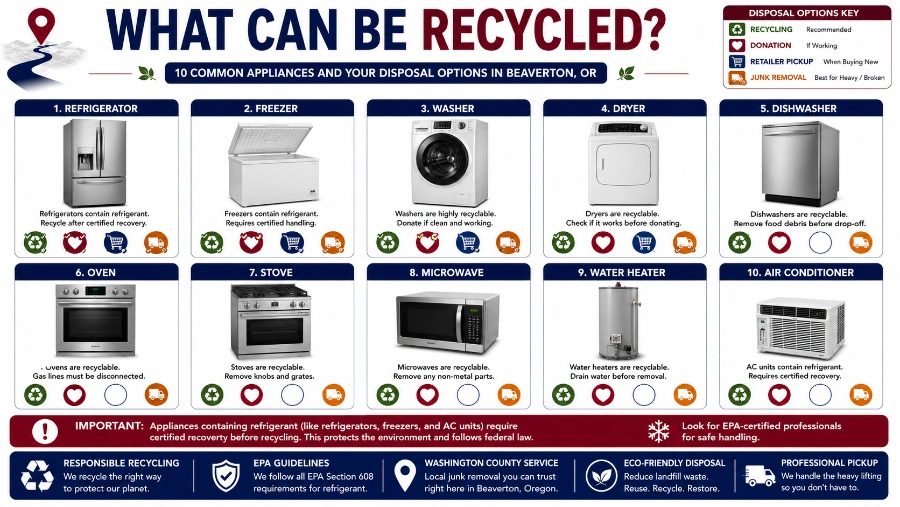
Here’s a quick reference for which disposal paths typically apply to which one in Beaverton.
| Appliance | Recycle | Donate | Junk Removal | Retailer Pickup |
|---|---|---|---|---|
| Refrigerator | Yes (refrigerant recovery required) | If working | Yes | Sometimes, with new purchase |
| Freezer | Yes (refrigerant recovery required) | If working | Yes | Rarely |
| Washer | Yes | If working | Yes | Sometimes |
| Dryer | Yes | If working | Yes | Sometimes |
| Dishwasher | Yes | If working | Yes | Sometimes |
| Oven / Stove | Yes | If working | Yes | Rarely |
| Microwave | Yes | If working | Yes | No |
| Water Heater | Yes | Rarely | Yes | Rarely |
| Air Conditioner | Yes (refrigerant recovery required) | Rarely | Yes | No |
Retailer pickup availability varies by store, location, and whether a new item is being delivered. Confirm current policy directly with the retailer before relying on it.
What Affects the Cost of Appliance Removal in Beaverton
Cost isn’t one flat number; it depends on a handful of specific factors that are worth understanding before you get a quote.
- Refrigerant content. Refrigerators, freezers, and air conditioners require certified refrigerant recovery, which adds a step and often a cost that washers or dryers don’t have. This is the single biggest factor separating a cooling appliance’s price from everything else on this list.
- Size and weight. Larger, heavier units take more labor to move safely and more truck space to transport, which generally makes them cost more than smaller units like microwaves or dishwashers.
- Access and stairs. An appliance in a basement, an upstairs unit, or behind a narrow doorway takes longer and more effort to remove than one sitting in a garage or driveway. Access is one of the most common reasons a quote changes once a crew sees the actual site.
- Distance to the truck. A long carry from the location to the curb or driveway adds time and labor, similar to how stairs do.
- Number of appliances. Bundling multiple household items into a single pickup is usually more efficient and often more cost-effective per item than scheduling separate trips for each one.
- Same-day vs. scheduled service. Faster turnaround can sometimes carry a premium compared to calling a few days ahead, depending on availability.
- Scrap value offset. Some of the cost may be offset by the recyclable metal content in the appliance, though this rarely covers the full cost of proper disposal on its own.
- Donation or retailer pickup as alternatives. If it still works, a donation or a retailer haul-away tied to a new purchase can reduce or eliminate the cost entirely, which is worth ruling out before assuming paid pickup is the only option.
For a broader look at how these factors apply across all types of junk removal, see our guide on what affects junk removal pricing in Beaverton.
Do Retailers Really Take Old Appliances for Free
Sometimes “free” usually comes with conditions attached.
Home Depot
Home Depot has offered haul-away service tied to delivery of a new one in the past, though availability, eligible appliance types, and any associated fee can vary by store and by product. Confirm current terms directly with the store or during checkout before counting on it.
Lowe’s
Lowe’s has similarly offered old-appliance removal in connection with a new delivery in some markets. As with any retailer program, treat this as something to verify at time of purchase rather than a guaranteed universal policy.
Best Buy
Best Buy has offered haul-away for certain large items and electronics purchased through them, typically tied to the delivery of the replacement item again; confirm exact eligibility and any fee before you rely on it for a specific purpose.
Will Best Buy Remove Any Appliance?
Not necessarily. Retailer haul-away programs are usually tied to buying a replacement item from that retailer and may only cover certain categories. Confirm the specifics with the store before assuming your old unit qualifies.
Commonly Accepted for Removal
Junk removal pickup in Beaverton, Aloha, Five Oaks, and the surrounding Washington County area typically covers the full range of major household items, including:
- Refrigerators
- Freezers
- Washers
- Dryers
- Dishwashers
- Ovens
- Stoves
- Microwaves
- Water Heaters
- Air Conditioners
If you’re not sure whether a specific item fits, it’s easiest to just describe it when you call.
How to Prepare for Pickup
A little prep makes pickup day faster and easier for everyone involved.
- Empty completely (no food, no leftover water in a washer or water heater)
- Defrost refrigerators and freezers ahead of time so there’s no water leakage during transport.
- Disconnect gas lines on gas ovens or stoves (or have this done by a qualified technician beforehand)
- Unplug it and, if possible, move it away from the wall.
- Clear a path from the appliance to the driveway or curb, especially for stairs or narrow hallways
- Let the crew know in advance about any tricky access to upper floors, tight doorways, or long carry distances.
Mistakes to Avoid When Disposing of an Appliance in Beaverton
- Leaving it at the curb without an approved pickup arranged: This risks fines and doesn’t guarantee it actually gets taken.
- Assuming a wardrobe has no donation value: check local donation options before defaulting to recycling.
- Not disconnecting or draining before pickup: This can slow down or complicate the pickup process.
- Assuming refrigerant doesn’t matter because the appliance “doesn’t work anymore”: refrigerant recovery rules apply regardless of whether the unit still runs.
- Not confirming retailer haul-away terms in advance: showing up expecting free removal that wasn’t actually part of the deal is a common surprise.
FAQs
Yes, washer and dryer pairs are commonly picked up together in a single visit since they’re usually removed from the same laundry area at the same time.
It’s best to avoid this if possible—equipment left out overnight can be exposed to weather, attract unwanted attention, or in some cases violate local code. If a crew needs it staged outside ahead of time, confirm the exact timing with them rather than leaving it out indefinitely.
If it’s in working condition, donation is usually the better option since it keeps a usable appliance out of the waste stream; recycling is the better fit once it’s no longer functional or repairable.
Not in terms of the disposal process itself, a broken washer is still recyclable, but a broken unit generally won’t qualify for donation, so recycling or junk removal pickup becomes the more realistic path.
Ready to Get Rid of That Old Appliance?
If your household item is too heavy, contains refrigerant, or you don’t have a truck, professional appliance removal in Beaverton may be the easiest option. Describe it when you call so we can confirm the correct pickup option for your situation. Whichever path you choose, make sure it’s handled legally and responsibly.
📞 (971) 297-3939 — Monday–Saturday, 6 AM–8 PM
🧮 Free cost calculator
Serving 97005, 97006, 97007, 97008, 97225, and 97229—Aloha, Cedar Hills, Five Oaks, Raleigh Hills, Bethany, and all of Washington County.
Related reading:
Which Disposal Method Is Right for My Appliance?
3 quick steps — get your personalized recommendation.
Refrigerators, freezers, and window AC units — yes.