What Junk Removal Companies Take in Beaverton — and What They Won’t
Junk removal companies in Beaverton, OR, take nearly anything non-hazardous—furniture, appliances, electronics, yard debris, construction debris, scrap metal, and mattresses. What they legally cannot remove includes wet paint, motor oil, propane tanks, asbestos, and medical waste. For anything in the grey zone, a quick call gives you a clear answer before pickup day.
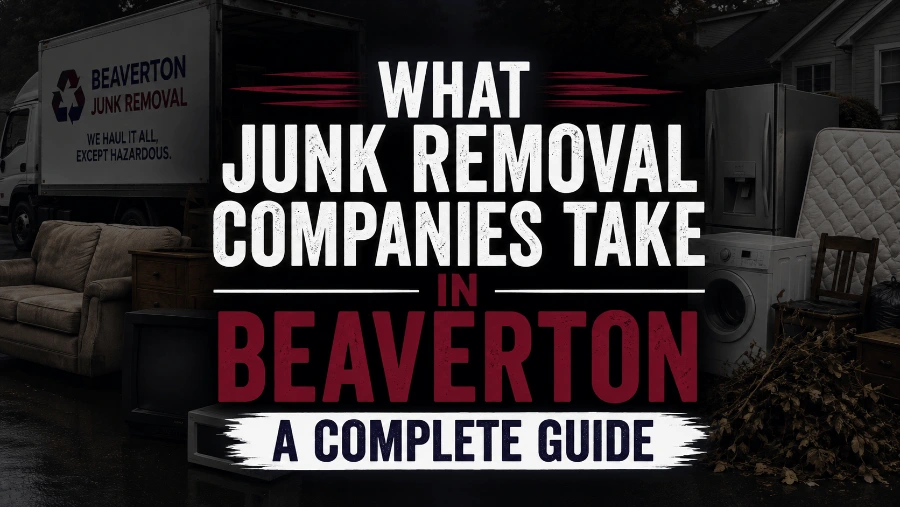
We get this situation all the time. A Cedar Hills homeowner is ready for a garage cleanout—furniture is stacked by the door, exercise equipment is in the corner, and a pile of boxes they haven’t opened since 2019 is there. Then they point to a full propane tank from the old grill, a box of half-dried paint cans, and a CRT television from 2003 and ask, “Is this what junk removal companies take in Beaverton, OR—or are some of these items restricted?”
Most of it, yes. The propane tank needs to go to an exchange program first. The paint depends on whether it’s dried solid or still liquid. The CRT TV goes through Oregon E-Cycles, which we handle as part of the job.
That conversation takes 90 seconds when you know the categories. Without knowing them, pickup day turns into a callback.
junk removal companies handle almost everything except hazardous waste, pressurized containers, and materials requiring certified removal like asbestos. Coolant appliances—fridges, AC units, and dehumidifiers—are collected but handled separately with a disclosed fee. Electronics are picked up and routed through Oregon’s E-Cycles program. Call (971) 297-3939 for a free estimate before anything is loaded.
Why Some Items Need Special Handling in Oregon
Every junk removal company in the country uses some version of the same line: “anything non-hazardous that two people can lift.” It’s a reasonable starting point.
The problem is that Oregon adds layers that most national guides don’t cover. The state bans electronics from standard garbage under Oregon E-Cycles disposal requirements. It requires certified refrigerant recovery before any coolant appliance can be disposed of. It classifies paint, motor oil, and pesticides as household hazardous waste under separate disposal rules.
None of that shows up in a generic items list.
So instead of just listing what we accept, this guide explains what we haul away, what we can’t legally remove, what gets special handling, and — for everything in the no column — exactly where to take it in Washington County.
What Junk Removal Companies Take in Beaverton — Full List
Here’s where most articles stop: a bullet list with no context. We’re going further.
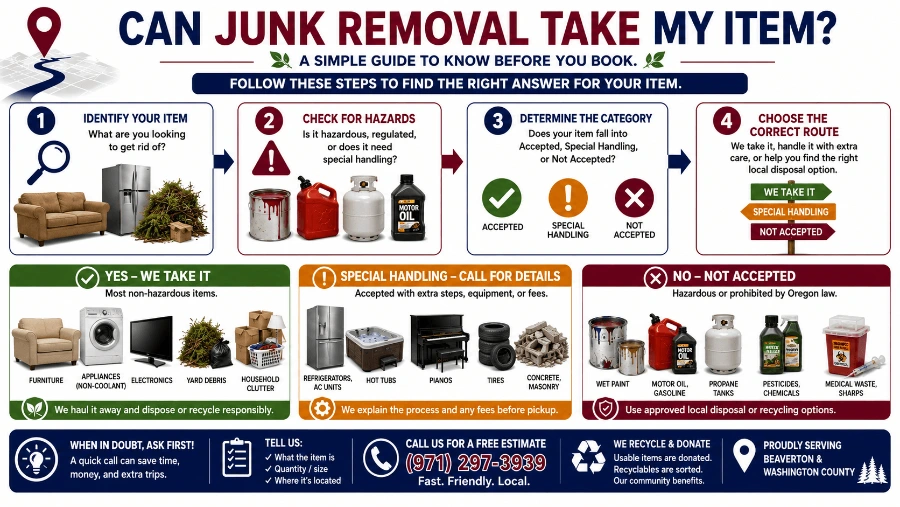
Every item below falls into one of three categories:
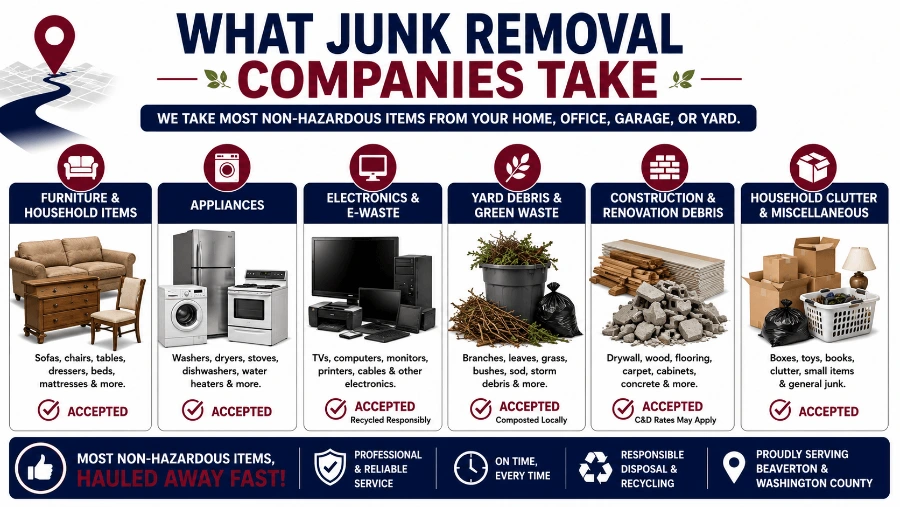
- ✅ Accepted — loaded directly, no extra steps
- ⚠️ Special handling — accepted, but with a separate process or fee disclosed upfront
- ❌ Not accepted — Oregon law or safety rules prohibit it; local alternative provided below
| Item | Accepted? | Notes |
|---|---|---|
| Sofas, sectionals, couches | ✅ | Donate if condition allows. |
| Bed frames, headboards | ✅ | Disassembled if needed |
| Mattresses | ✅ | An Oregon disposal fee may apply. |
| Dressers, wardrobes, desks | ✅ | From any room, any floor |
| Dining tables and chairs | ✅ | — |
| Office furniture | ✅ | Commercial quantities are fine. |
| Exercise equipment | ✅ | Treadmills, weights, ellipticals |
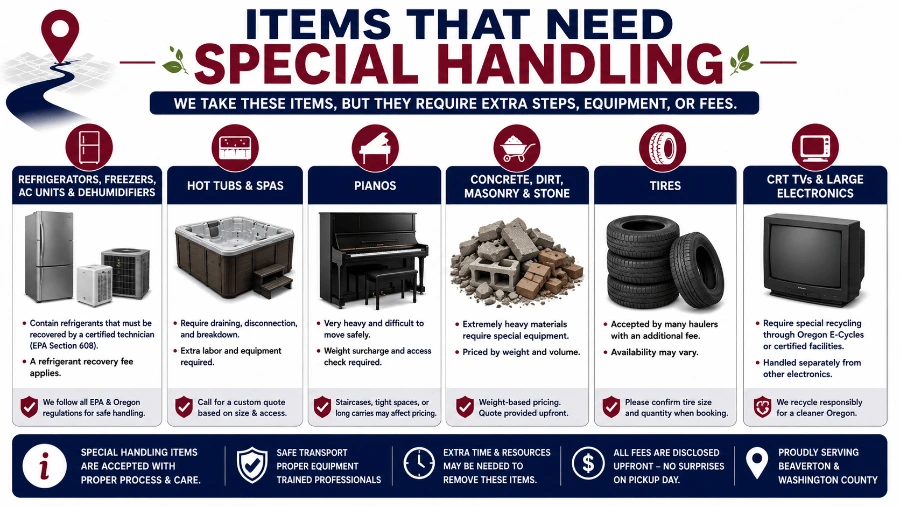
| Pianos | ⚠️ | Weight surcharge; access check required |
| Hot tubs | ⚠️ | Breakdown required; separate quote |
| Washers, dryers, stoves | ✅ | No refrigerant — standard removal |
| Refrigerators, freezers, AC units, dehumidifiers | ⚠️ | Refrigerant recovery fee — EPA Section 608 |
| Water heaters, dishwashers | ✅ | — |
| TVs, monitors, computers | ✅ | Recycled via Oregon E-Cycles |
| Other electronics | ✅ | Routed to certified e-waste processors |
| Branches, leaves, sod, storm debris | ✅ | Washington County composting |
| Lumber, drywall, carpet, flooring | ✅ | C&D rates may apply. |
| Concrete, dirt, masonry | ⚠️ | Weight-based; quoted separately |
| Scrap metal, copper, aluminum, steel | ✅ | Metal recycling may offset removal costs. |
| Clothing and textiles | ✅ | Donation route |
| Boxes, general household clutter | ✅ | — |
| Tires | ⚠️ | Accepted by some haulers with a fee; confirm when booking |
| Wet or liquid paint | ❌ | Metro HHW facility — free for households |
| Motor oil, gasoline | ❌ | Auto parts stores / Metro HHW facility |
| Propane tanks (full or partial) | ❌ | Tank exchange: Home Depot, Lowe’s |
| Pesticides, herbicides, pool chemicals | ❌ | Metro HHW facility |
| Asbestos-containing material | ❌ | Licensed abatement contractor required; small household amounts accepted at Metro HHW (call first) |
| Medical waste, sharps | ❌ | Participating pharmacy kiosks (Washington County); Metro HHW facility; Metro sharps collection boxes |
| Biohazard material | ❌ | Certified biohazard cleanup service |
| Ammunition, fireworks | ❌ | Contact local law enforcement’s non-emergency line. |
| Car and lithium-ion batteries | ❌ | AutoZone, O’Reilly (free core return) |
The sections below explain the most important categories in depth — why certain items need special handling, what Oregon-specific rules apply, and where to route anything we can’t take.
Can Junk Removal Take a Refrigerator in Beaverton?
Yes. Most refrigerators require an additional refrigerant recovery fee because they contain regulated refrigerants. Under EPA Section 608, those refrigerants must be recovered by a certified technician before the appliance can be recycled or disposed of safely.
Reputable junk removal companies explain any refrigerant recovery fee before pickup begins. Once the refrigerant has been removed, the appliance is typically processed for scrap metal recycling. Before scheduling pickup, it’s also worth checking whether your local utility provider offers an appliance recycling program. PGE and Pacific Power sometimes offer refrigerator recycling incentives or pickup programs, although availability and eligibility may vary.
Furniture — What We Take, What We Donate, and the Grey-Zone Items
Furniture is the most common category in any junk removal job. Sofas, bed frames, dressers, dining sets, office chairs, bookshelves—all hauled away, regardless of condition. We go into any room to collect it: upstairs bedrooms, basement storage, and detached garages.
Condition doesn’t determine whether we remove it. Only hazard does. A broken sofa with a torn armrest goes on the truck just like a clean one. The difference is where it ends up.
Clean, structurally sound pieces in good condition go to our donation partners — Goodwill, Habitat ReStore, or St. Vincent de Paul in Tigard. Habitat ReStore specifically accepts furniture alongside building materials, which makes them a good fit for renovation cleanouts. Pieces with significant damage, pet staining, mold, or broken frames go to disposal rather than donation, but they still leave your property.
The grey-zone pieces homeowners ask about most:
Pianos. Accepted, but not at standard pricing. Upright pianos are dense and heavy — moving one safely requires more crew time, and the structural access of the room matters. We quote piano removal separately after assessing access. If a piano is in good condition and playable, some local music programs will accept donation pickups—it’s worth a call before scheduling removal.
Hot tubs. Accepted, but they require breakdown on-site—cutting into sections before loading. This adds labor time and affects the quote. See our large item removal page for more detail on hot tub jobs specifically.
Pool tables, swing sets, outdoor structures. Accepted with disassembly. Slate pool tables are particularly heavy — the slate bed alone can weigh several hundred pounds per section. Always mention these when booking so we can bring the right crew size.
If you’re deciding between donating furniture yourself versus hiring someone, our guide on what junk removal companies take versus what charities accept breaks down that decision clearly for a clear breakdown of when each option makes sense. For free pickup options from local charities, the free furniture pickup guide covers exactly which organizations serve the area and what they accept.
Appliances — Standard Removal vs. Coolant Appliances
This is the category that generates the most confusion on pickup day — and it’s worth understanding before you call any junk removal company.
Standard appliances — collected at no extra fee: Washers, dryers, stoves, ovens, dishwashers, water heaters, microwaves. These don’t contain refrigerant, so they load like any other large item. Most go to scrap metal processors after pickup—they carry real material value that offsets disposal costs.
Coolant appliances—refrigerant recovery required: Refrigerators, freezers, window and central AC units, dehumidifiers, and wine coolers. These all contain refrigerants that are illegal to vent into the atmosphere under EPA Section 608 of the Clean Air Act. Oregon DEQ also enforces this under ORS Chapter 468.
What this means practically: before any coolant appliance can be disposed of, a certified technician must recover the refrigerant. We handle this as part of the job. The fee is disclosed when you call — it’s a separate charge, not a surprise at the end.
This applies regardless of the appliance’s age. A brand-new fridge that stopped working has the same requirement as a 30-year-old chest freezer.
One thing worth knowing: some utility companies in Washington County offer free or rebated appliance pickup programs—especially for older refrigerators. If your fridge still runs and you’re replacing it, check with PGE or Pacific Power before scheduling removal. You might get a rebate on top of free pickup.
For commercial kitchen equipment, industrial refrigeration units, or multiple appliances from a rental property or business, see commercial junk removal page for volume pricing.
Electronics — Oregon’s E-Cycles Law Changes What “Standard” Means
Oregon was one of the first states to ban electronics from standard garbage. Under ORS 459A.300–.365, computers, monitors, and televisions cannot go in a regular waste load. This isn’t a preference — it’s a legal requirement with penalties for unlicensed disposal.
The state program that handles this is Oregon E-Cycles. It’s free for households and small organizations: up to seven devices per visit at public drop-off locations, working or broken, no appointment needed. Electronics handled through E-Cycles include desktops, laptops, monitors, TVs, tablets, printers, keyboards, and mice.
When a professional crew picks up electronics, they’re routed through this same program—it just happens without you making a separate trip. For larger volumes, like an office cleanout or a storage unit full of old equipment, professional pickup avoids the per-visit limits at public drop-offs.
The CRT television question. Older cathode-ray televisions from the late 1990s and early 2000s are a common find in local garages and storage rooms. They’re bulky and heavy, and CRT glass contains lead. They’re accepted—but they go through E-Cycles, not general disposal. This occasionally surprises people who expect them to be declined entirely. They’re not. They just need the right processing chain.
Will Junk Removal Take Paint Cans in Beaverton?
Yes — if the paint is completely dry. Most local junk removal companies can collect hardened paint cans, but liquid paint is classified as household hazardous waste under Oregon regulations and must be taken to a Metro Household Hazardous Waste facility.
If only a small amount of paint remains, you can usually harden it by mixing in kitty litter or sawdust and leaving the lid off until it dries completely. Before calling for pickup, check each can so you know whether it can go with the rest of your load or needs to be taken to Metro HHW first.
Can Junk Removal Take a Hot Tub in Beaverton?
Yes. Most hot tubs must be dismantled on-site before they can be removed safely because they usually can’t be moved in one piece. Crews typically cut the shell into manageable sections before loading it for disposal.
When you call, let the company know whether the hot tub is above-ground or deck-mounted, whether it has been drained, and how much access there is from the backyard to the street. These details help determine the crew size, equipment, and pricing. If the hot tub is built into a deck or another structure, call ahead so the team can recommend the safest removal approach. See our large item removal page for more detail on how these jobs are handled.
Yard Debris — What’s Accepted and Where It Goes
Branches, leaves, sod, grass clippings, storm debris, shrubs, root balls — all accepted. Beaverton properties, especially in Cedar Hills, Bethany, and Five Oaks, where mature tree coverage is heavy, regularly produce more yard debris than a standard WM cart can handle.
After pickup, organic yard waste goes to Washington County composting or green waste processing facilities — not a landfill. Oregon DEQ guidelines require yard debris to be diverted from the general waste stream when possible. Branches become wood mulch. Leaves and grass become soil amendments.
What doesn’t work in a yard debris load: debris contaminated with non-organic material. Branches mixed with rocks, plastic bags, metal stakes, or concrete pieces can’t enter the composting stream and get reclassified as general waste—which costs more at disposal. Keep your yard debris pile clean and separated before we arrive.
The Woodco option. For yard debris only — no household junk mixed in — Woodco at 3011 SW 170th Ave in Beaverton accepts clean yard debris and clean concrete at lower rates than Metro transfer stations. If you have a truck and a single clean load, it’s a worthwhile option. If you have yard debris plus other household junk to clear, or no truck, a local crew handles the entire job in one pickup.
For a full breakdown of yard debris removal pricing by debris type and load volume, see “yard debris removal cost in beaverton guide.” For the full service, see yard debris removal in Beaverton.
Construction and Renovation Debris
Most people are surprised by how much what junk removal companies take extends into renovation territory — drywall, flooring, old cabinets, fencing. Post-renovation cleanup is one of the messier jobs in the industry, and one of the most satisfying to see cleared out.
What we take: drywall, lumber, flooring (hardwood, laminate, tile, carpet), cabinets, countertops, roofing shingles, windows, doors, old insulation (non-asbestos), fencing, and general construction scraps.
What gets priced differently: concrete, dirt, brick, and masonry are accepted but quoted by weight rather than by truck volume. These are the heaviest materials in any cleanout, and disposal facilities charge by the ton. A small amount of broken concrete can add meaningful weight to a load—always mention it when booking so your estimate reflects it accurately.
The asbestos question. Washington County has significant housing stock built before the 1980s, when asbestos was commonly used in floor tiles, insulation, popcorn ceilings, pipe wrapping, and drywall texture. If you’re renovating a home built before 1980—or before 2004 for certain materials—suspect any insulation or tile until it’s tested.
Oregon requires documentation for construction debris from pre-2004 buildings at Metro transfer stations. We cannot haul materials suspected of containing asbestos without testing results. If testing confirms asbestos, a licensed abatement contractor handles removal and disposal. Households can bring small amounts—up to two 25-pound, double-bagged, and sealed 6-mil bags—to the Metro HHW facility (call 503-234-3000 before arrival). After abatement is complete, we can haul the remaining clean debris.
If you have questions about what qualifies, call before scheduling — it’s a five-minute conversation that prevents a wasted trip.
For construction debris mixed with general household junk, the house cleanouts page covers combined projects.
What Junk Removal Companies Cannot Remove — and Where to Take It Instead
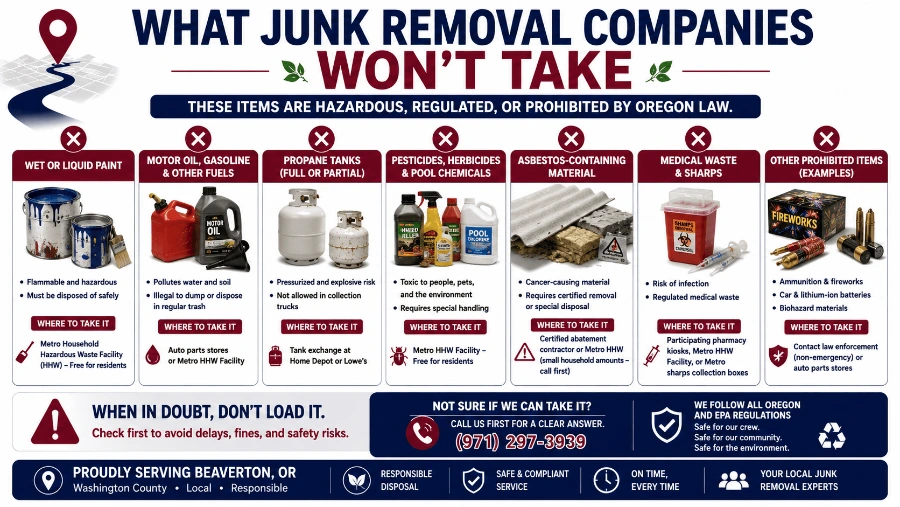
For everything in the ❌ column, there’s a local solution. Here’s the routing guide:
| Item | Why We Can’t Take It | Where to Take It Locally |
|---|---|---|
| Wet / liquid paint | Household hazardous waste — Oregon HHW rules | Metro HHW facility at Metro Central or Metro South · Free for households · Check current operating hours before visiting. |
| Motor oil, gasoline | Hazardous — fire and spill risk | O’Reilly Auto Parts (free recycling, confirm locally); AutoZone (most locations accept used oil — call ahead); Metro HHW facility |
| Propane tanks (full/partial) | Pressurized — explosion risk in truck | Tank exchange: Home Depot, Lowe’s, most hardware stores |
| Pesticides, herbicides, pool chemicals | Hazardous waste — ORS Chapter 468 | Metro HHW facility · Free for households |
| Asbestos-containing material | Certified abatement required by federal and Oregon law | Metro HHW facility accepts small amounts from households only—up to two 25-lb, double-bagged, and sealed 6-mil bags per day. More than 50 lbs: licensed landfill required. Call 503-234-3000 first. |
| Medical waste / sharps | OSHA bloodborne pathogen standards: illegal to discard in Oregon garbage | Participating pharmacy kiosks; Metro HHW facility; Metro sharps collection boxes (residents only — call 503-234-3000) |
| Ammunition, fireworks | State and federal law | Contact your local law enforcement agency via their non-emergency line—the Oregon State Fire Marshal recommends this for unwanted fireworks disposal. |
| Biohazard material | Requires specialized certified contractor | Certified biohazard cleanup company |
| Car batteries / lithium-ion batteries | Hazardous recycling required | AutoZone, O’Reilly, Batteries Plus — free core return programs |
| Tires | Disposal restrictions and fees | Tire retailers (small fee); Washington County periodic collection events |
Metro’s Household Hazardous Waste program is one of the most useful resources for Washington County residents. It’s free for eligible household hazardous waste and accepts paint, motor oil, batteries, pesticides, and many other materials that regular junk removal companies cannot collect. Before visiting Metro Central or Metro South, check the current operating hours and any visit requirements on Metro’s official website.
For a full routing guide including donation options, curbside programs, and transfer station details, see where to take junk in Beaverton guide. For the common Metro South mistakes that catch first-timers off guard, see the Metro South transfer station guide.
You should also review and prepare for junk removal guide before pickup day—it walks through exactly how to stage items and separate anything that needs special handling.
Donate First, Haul Second — How We Sort Every Load
Every load we haul gets evaluated before anything goes to disposal. When you hire a junk removal company, items in usable condition go to donation partners — Goodwill, Habitat ReStore, or St. Vincent de Paul. Materials with recycling value — metal, electronics, clean organic debris — go to the appropriate certified processor or composting facility. What remains after those decisions is what actually ends up at a licensed transfer station.
That sorting process is what separates a junk removal company that takes disposal seriously from one that doesn’t. It’s also the reason a professional pickup often produces less landfill waste than a single DIY transfer station run where everything gets dumped together.
Here’s how the decision tree works:
- Furniture in usable condition → Goodwill, Habitat ReStore, or St. Vincent de Paul. We have ongoing relationships with all three. Habitat ReStore accepts furniture alongside building materials. St. Vincent de Paul in Tigard offers scheduled donation pickup for large pieces. Goodwill serves multiple locations along TV Highway and Canyon Road.
- Scrap metal → certified metal recyclers. Copper, aluminum, steel, brass — all have scrap value that gets passed back into the process. This is also why washers and dryers often cost less to remove than you might expect; the scrap value offsets disposal costs.
- Electronics → Oregon E-Cycles certified processors. Data on hard drives is destroyed before materials are recycled.
- Yard debris → Washington County composting facilities. Branches become mulch. Leaves and grass become soil amendments.
- Everything else that can’t be donated or recycled → licensed transfer stations, properly sorted by material type.
The reason this matters to you: if items in your load are in good condition and can be donated, that sometimes affects the final cost. We assess this during the on-site estimate.
For a complete breakdown of where your items go after pickup, see Where Does Junk Go After Removal guide. For more on donation-first decisions, see Donate furniture or hire junk removal. And for the full story on our disposal approach, see our promise page.
When a Transfer Station Makes More Sense Than Hiring a Company
We’ll be direct about this: not every situation calls for a professional crew.
If you own a truck, have a single manageable load of non-donatable material, and have two people to help load, a self-haul trip to a transfer station is a perfectly reasonable option. Metro Central in Portland is about 20 minutes from most local ZIP codes. Metro South in Oregon City has extended hours until 7 PM for after-work runs.
The math starts to shift when you don’t own a truck (truck rental is $65–$110 for a half-day), when your load would take more than one trip, when you have items that require special sorting before a facility will accept them, or when you’re dealing with heavy items that need more than two people.
For yard debris specifically, Woodco at 3011 SW 170th Ave is inside city limits and accepts clean yard waste at lower rates than either Metro station. If yard debris is the only thing you have and you have a truck, that’s a short drive at a lower cost.
The transfer station near Beaverton guide covers all five local facilities—fees, hours, accepted items, and prep checklist—if you want to make that trip as smooth as possible.
What about phones, small appliances, and other electronics?
Smartphones and tablets go through e-waste processors rather than e-cycles (which specifically covers computers and TVs). Small appliances—toasters, blenders, and coffee makers—are general waste unless they contain rechargeable lithium-ion batteries, which require separate handling.
If data destruction matters to you, hard drives from computers and laptops are processed by certified e-waste handlers who destroy data before materials are recycled. Ask about documentation when booking if you need it for compliance reasons. For large-volume electronics recycling, see our dedicated electronics recycling page.
Common Mistakes Homeowners Make Before Pickup Day
These are the situations that create extra cost, delayed pickups, or last-minute surprises. Most of them take less than five minutes to avoid.
- Mix hazardous materials into the load without mentioning them. A box of liquid paint cans at the bottom of a stack, propane tanks tucked behind the garage shelves. When these turn up during loading, it creates a stop — sometimes a reschedule. Mention them when you book, and we’ll tell you exactly where to route them first.
- Assume all appliances cost the same. A washer and a refrigerator are different situations. The washer loads like any other large item. The fridge needs refrigerant recovery under EPA Section 608. The fee is disclosed upfront—but only if you know to ask.
- Bag yard debris before we arrive. It takes time you don’t need to spend, slows loading, and doesn’t reduce your cost. Stage loose debris in an accessible area and leave it there.
- Call without a rough list of what you have. “I have a lot of stuff” is hard to quote accurately. “Two sofas, a fridge, a washer/dryer, and about twenty boxes” takes 60 seconds and gets you a real number on the first call.
- Assume old or damaged belongings won’t be removed. A broken exercise machine, a sofa with a ripped cushion, a dresser missing a drawer — none of those are grounds for refusal. Condition doesn’t determine whether we haul it away. Hazard does.
- Leave no clear path to the items. If the crew needs to move other belongings to reach what we’re collecting, that adds labor time. A clear route to the truck — especially for upstairs rooms or backyard debris — keeps the job efficient and the cost predictable.
How different factors affect your final cost, see what affects junk removal pricing guide in Washington county.
Frequently Asked Questions
Yes, but hot tubs require on-site breakdown before loading—they can’t be moved intact. This adds labor time and affects pricing. Mention it when booking so we can bring the right crew. For full details, see large item removal in Beaverton.
Yes — drywall, lumber, flooring, carpet, cabinets, and roofing shingles are standard. Concrete, dirt, and masonry are accepted but priced by weight, so always mention them when booking. Materials suspected of containing asbestos require testing before removal.
Yes. Clothing, bedding, curtains, and textiles go to donation partners when in usable condition. Damaged textiles are handled through general disposal.
This varies by company. Some accept tires with an additional fee. Others decline. Confirm when booking. If tires are declined, tire retailers typically accept them for a small recycling fee, and Washington County occasionally runs collection events.
Usable items go to donation partners—Goodwill, Habitat ReStore, and St. Vincent de Paul. Metals go to certified recyclers. Electronics go through Oregon E-Cycles. Yard debris goes to Washington County composting. Only what can’t be diverted goes to a licensed transfer station. See where junk goes after removal in Beaverton for the full breakdown.
Not Sure What Junk Removal Companies Take in Beaverton?
Call and ask. It takes 90 seconds to confirm whether something goes on the truck, needs special handling, or needs a different route entirely. We’d rather answer that question before dispatch than on your driveway.
📞 (971) 297-3939 — Monday–Saturday, 6 AM–8 PM
Serving 97005, 97006, 97007, 97008, 97225, and 97229—Cedar Hills, Bethany, Five Oaks, Raleigh Hills, Aloha, and all of Washington County.
Will Junk Removal Take My Item?
2 quick steps — instant ✅ ⚠️ ❌ answer.