Hoarder Cleanout in Beaverton: Real Costs, Honest Process, No Judgment
A hoarder cleanout in Beaverton typically costs between $1,500 and $5,000+ for a full home, depending on volume, access difficulty, sorting complexity, and whether any sanitation issues are involved. The process is slower and more involved than standard junk removal; it’s done room by room, with items sorted rather than shoveled out, and a proper estimate almost always requires an in-person walkthrough.
A daughter driving in from Hillsboro finally sees her father’s Cedar Hills house in person for the first time in two years and realizes the “a little cluttered” he mentioned on the phone actually means a hallway she can’t walk through and a kitchen counter that hasn’t seen daylight in months. She spends the whole drive home trying to figure out where you even start, and whether calling someone means admitting things have gotten as bad as they look. That’s the exact moment this guide is for.
How a Hoarder Cleanout in Beaverton Differs From Regular Junk Removal
Standard junk removal is designed for a different problem: you point at what you don’t want, the crew loads it, and it’s gone in a few hours. That model works for a garage cleanout or a few rooms of furniture. It doesn’t work well for a hoarding situation, where the volume is much larger, items of importance are often buried throughout, and rushing creates its own problems. Three differences matter most in practice.
Volume and Time
What reads as “a lot of stuff” in a regular cleanout is often an entire home’s worth of accumulated items in a hoarding situation, sometimes years or decades of it. A crew that clears a truck in two or three hours needs to plan for a multi-day project, moving room by room rather than trying to push through everything at once.
Sorting, Not Just Hauling
Important documents, medications, financial paperwork, and family photos end up buried in hoarding situations, sometimes in ways that aren’t obvious from a glance at the pile. A crew that shovels everything into a truck risks discarding irreplaceable items. A proper cleanout builds in time to separate anything personal or potentially important so the homeowner or family can make the call on those items.
Pace and Involvement
Some people want the whole job done as quickly as possible and want the crew to make decisions. Others need to be in the room for every decision. A crew worth hiring will ask you upfront about your preferences instead of making assumptions. If you’re weighing what to do with specific furniture or appliances that may be worth donating, our guide on donating furniture vs. hiring junk removal covers that decision in more detail.
Comparison: Standard Junk Removal vs. Hoarder Cleanout
| Factor | Standard Junk Removal | Hoarder Cleanout |
|---|---|---|
| Typical timeline | 1–3 hours | 1 full day to several days |
| Typical cost | A few hundred dollars for a partial load; $500–$800 for a full truck | $1,500–$5,000+ for a full home |
| Sorting required | Minimal | Extensive — items sorted as cleared |
| Crew approach | Load and haul | Room-by-room, at the homeowner’s pace |
| Family involvement | Optional | Often central to the plan |
Costs vary based on volume, access difficulty, and sorting complexity. Call for an estimate based on your specific situation.
Is a Hoarder Cleanout the Same as an Estate Cleanout?
Not always. An estate cleanout is organized around clearing a property after a life event: a death, a move into assisted living, or a home sale. It’s defined more by volume and sorting complexity. The two can happen at the same time or separately. The process is similar; the emotional dynamics can differ.
What the Process Actually Looks Like, Start to Finish

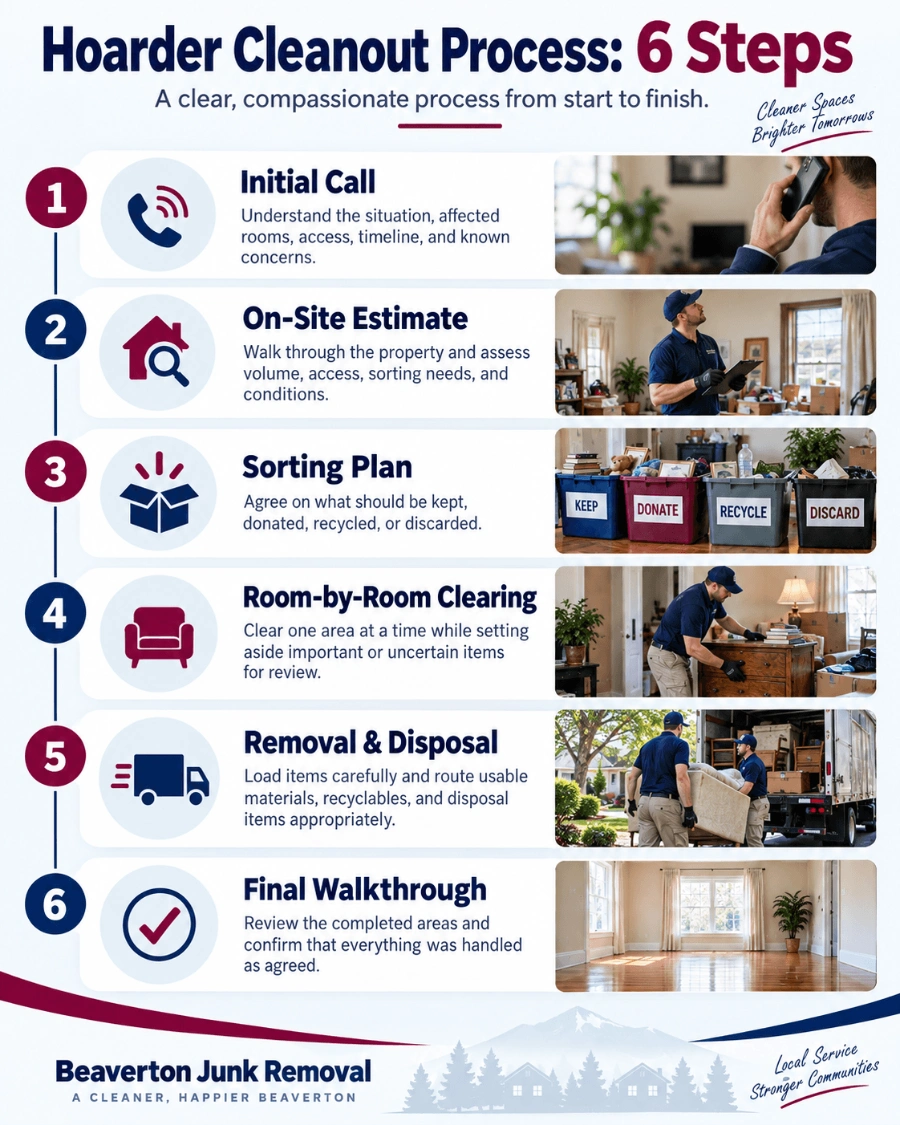
Most people calling about a hoarder cleanout in Beaverton have never been through one before, so knowing what to expect at each step makes the whole thing less overwhelming. Here’s how a typical job unfolds, from the first phone call to the final walkthrough.
The First Phone Call
The first call isn’t a sales conversation; it’s a chance to describe what you’re dealing with so the crew can understand whether an in-person estimate makes sense and roughly what the scope might be. The more useful information you can share upfront, the better: how many rooms are affected, whether anyone is currently living in the home, whether there are any known sanitation concerns (pest activity, mold, or spoiled food), and whether there’s a hard deadline involved — a home sale, a lease ending, or a family member’s return.
If you’re not sure how to describe the scope, an honest “I don’t know where to start” is a completely normal starting point.
The On-Site Estimate
Photos and phone descriptions don’t tell the full story — access issues, stacked weight, narrow hallways, and condition details almost always only become clear in person. An on-site walkthrough is how the crew confirms what the job actually involves before giving a price. It’s also when the sorting approach gets planned: which rooms start first, how items get categorized, and what gets set aside for the homeowner to review.
A few things worth disclosing before the estimate visit:
- Any known structural concerns (floors weakened by stacked items, compromised stairs)
- Known pest activity, mold, or sewage-related issues
- Whether valuables, medications, or important documents are somewhere in the home
- Whether the person living there will be present during the cleanout
Agreeing on the Sorting Plan

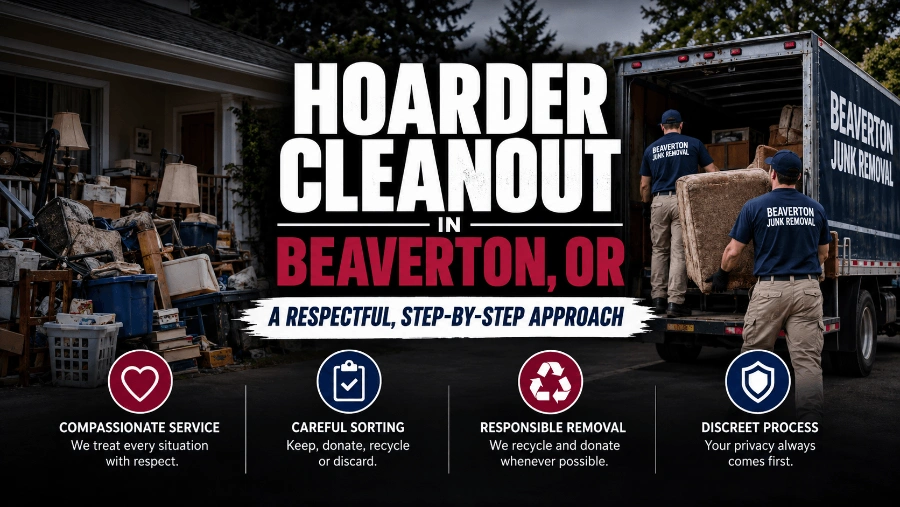
Before anything moves, the crew and homeowner or family member agree on categories: keep, donate, recycle, or discard. This is the most important conversation in the whole job. The most common source of regret in a cleanout isn’t the cost; it’s something meaningful that ended up on a truck before anyone realized it was there.
A few practical notes on how this usually works: obvious trash and clear duplicates are the easiest starting category to agree on. Sentimental items, family photos, and documents should be set aside early in a designated review area rather than sorted on the fly. Usable furniture and working appliances can often go to donate to the Habitat for Humanity ReStore in Beaverton, and Goodwill locations throughout the Portland metro area accept a wide range of items. Electronics are recycled separately through Oregon E-Cycles, which accepts up to seven items free at multiple drop-off locations. Our electronics recycling guide and metal recycling page explain how those pieces factor into a larger cleanout.
Room-by-Room Clearing
Work moves one room at a time, not because it’s slower, but because it keeps the sorting organized and makes it easy to see actual progress. Items flagged for homeowner review go to a designated staging area rather than directly onto the truck. Once a room is cleared, it stays cleared.
Final Walkthrough
Before the crew leaves, a walkthrough confirms that everything was handled as agreed, the review pile is accessible and intact, and there are no loose items or debris left behind. This is also the right time to ask about next steps — whether a follow-up visit makes sense, what happened to donated or recycled items, and what documentation the job generated.
What If I’m Not Ready to Commit to a Full Cleanout Yet?
A partial cleanout of one room, one area of the home, or a first phase followed by more later is a completely normal request. So is calling just to describe the situation and understand what a project would involve before committing to anything. There’s no obligation on the first call, and no pressure to schedule on the spot.
What Drives the Cost of a Hoarder Cleanout in Beaverton
This can’t be quoted meaningfully from a flat-rate menu because the variables that matter most — volume, access, and sorting complexity — only become clear in person. That said, understanding what drives the number up or down helps you know what to expect before the estimate visit.
- Total volume and affected space. A single-room situation and a whole-home situation are priced completely differently. The more of the home is affected, the more truck trips and labor hours are involved.
- Access difficulty. Blocked hallways, narrow paths through stacked items, stairs, or limited vehicle access to the property all slow the crew down and add time.
- Sorting complexity. A job where the homeowner or a family member is present and can make quick decisions moves faster than one where the crew must set aside large quantities for review.
- Sanitation conditions. Pest activity, mold, spoiled food, or sewage-adjacent conditions require additional precautions, and in some cases a licensed biohazard remediation company needs to be involved.
- Timeline pressure. Clearing a home in two days versus spreading work over two weekends may affect pricing depending on crew availability.
- What offsets cost. Usable furniture, working appliances, and scrap metal can sometimes reduce disposal costs when diverted through donation or recycling.
As a realistic reference, a full hoarder-level home cleanout in the Beaverton and Portland metro area generally falls somewhere between $1,500 and $5,000, with extreme situations involving significant sanitation remediation running higher. Single-room or partial cleanouts are typically much less. If cost is a concern before you’re ready to commit, ask about a phased approach or payment options when you call — both are common requests. For more on how junk removal pricing works in general, see our guide on what affects junk removal pricing in Beaverton.
When the Person Living There Isn’t Ready for a Full Cleanout

This is one of the most common situations we hear about, and it deserves a straight answer rather than a workaround. If you’re a family member trying to help a parent or relative who isn’t on board yet, a full-speed cleanout is often the wrong move — not because it’s wrong to want the space cleared, but because pushing too hard and too fast can damage the relationship and make the person more resistant to future help. There’s a real difference between a situation where the resident has agreed to help and one where the family is making decisions the resident hasn’t accepted yet.
A few things that tend to work better than an all-at-once push:
- Start with one functional area. Clearing a path to the stove, restoring a usable bathroom, or reclaiming a bed to sleep in is a meaningful win and a concrete starting point. It demonstrates that the process doesn’t have to mean losing everything.
- Start with obvious trash, not sentimental items. Expired food, clearly broken items, and exact duplicates are much easier to agree on than family photos or collections. Building agreement on easy decisions creates momentum for harder ones.
- Let the crew be a neutral voice. Sometimes a recommendation is easier to accept from a professional who isn’t family. If the homeowner has been resistant to family suggestions, letting the crew propose the initial plan can reduce friction.
- Consider a phased approach. A single-room or partial cleanout completed at a pace the resident can accept is a real service option, not a workaround or a lesser version of the job.
If the person involved is open to additional support, the Multnomah County Hoarding Task Force’s Buried in Treasures program is a 16-week peer-support workshop specifically for people struggling with hoarding behavior. The NW Anxiety Institute offers both individual treatment and group support in Portland.
What If My Family Member Doesn’t Want Help Yet?
You’re not alone in this; it’s one of the most common situations we hear about. A full cleanout isn’t the only option. A partial cleanout, a single-room start, or simply having a crew come out for a conversation rather than to haul everything out the same day can all be reasonable first steps. Describe the situation honestly when you call — the plan can be built around what the homeowner is willing to accept, not just what the family wants done.
Safety and Sanitation: What You Should Know Before the Crew Arrives

Not every cleanout is just a volume problem — some involve conditions that require more careful handling. Knowing which category your situation falls into before the crew arrives makes the job safer and avoids surprises on the day.
- Mention known issues upfront. If there’s active pest activity, visible mold, spoiled or rotting food, or signs of animal waste, say so on the first call. It’s not a disqualifying condition — it’s information that lets the crew prepare properly.
- Biohazard situations have a different threshold. A general cleanout crew can handle unpleasant conditions: an overloaded kitchen, heavy dust, mildew smells, and general grime. What they’re not equipped to handle is active sewage contamination, confirmed mold remediation, or significant biological waste. In those cases, a licensed biohazard remediation company typically needs to work first.
- Structural issues. Homes where items have been stacked for years sometimes have floors under stress. If you suspect structural concerns, flag it before work starts so the crew can adjust how they move and load.
- Medications and controlled substances. These sometimes turn up during a cleanout. Expired medications cannot go in regular trash or recycling in Oregon. The Beaverton Police Department has a medication drop-off for safe disposal.
Do You Handle Situations With Mold, Pests, or Sewage Issues?
General sanitation-related cleanouts — including heavy clutter, dust, mildew, and overloaded kitchens — are within the normal scope of this work. Situations involving active sewage contamination, significant mold remediation, or biological waste typically require a licensed remediation specialist first. Describe the conditions honestly when you call, and we’ll tell you whether additional expertise is needed before we start.
Common Situations That Lead to a Hoarder Cleanout in Beaverton

Most people who call are dealing with one of a handful of situations. The service looks similar in each case, but the pace and approach often need to be tailored to fit.
- Helping a parent transition to assisted living or memory care. Often the most emotionally complex version of this job, because the person may not be present for the cleanout and family members are making decisions they know are permanent.
- Preparing a home for sale after a death. A combination of estate cleanout and hoarder cleanout — the house needs to be cleared, but so does a lifetime of accumulated possessions. See our full guide on house cleanout services for how this kind of project typically unfolds.
- Rental property turnover. A tenant who left behind years of accumulated items is a different project from a tenant who left behind a mess. Landlords usually need an in-person assessment before getting an accurate estimate.
- A family intervention. The resident is present, the family has organized help, and the goal is reclaiming livable space without destroying the relationship.
- Code compliance. A city notice, HOA complaint, or fire marshal flag has created a deadline. These situations often have more urgency and may require documentation of what was removed.
- A personal fresh start. Someone who has decided on their own that it’s time is often the most cooperative and efficient version of this job.
Whatever brought you here, the approach should fit the specific situation. If you’re not sure what to expect on the day of service, our guide on how to prepare for your junk removal appointment covers the basics that still apply here, just scaled up.
Questions to Ask Before You Hire a Hoarder Cleanout Company
Not all junk removal companies are set up to handle a true hoarding situation. Before committing, a few questions are worth asking directly:
- Do you do an in-person walkthrough before quoting? Any company quoting a full-home hoarder cleanout based on photos alone should be treated with skepticism.
- How do you handle items that might be important? The answer should involve setting things aside for review, not a vague “we sort as we go.”
- What happens if we find a biohazard situation you’re not set up for? A trustworthy company will tell you honestly if something exceeds their scope.
- Can we work in phases if the resident needs a slower pace? If they can only do all-or-nothing, that’s useful to know before you book.
- Where do items go? Donation routing (Habitat ReStore Beaverton, Goodwill, and St. Vincent de Paul in Tigard), recycling (Oregon E-Cycles and Metro Central), and landfill disposal should all be part of the answer.
- Are you licensed and insured? Relevant for any crew working inside a residence, especially in challenging conditions.
Frequently Asked Questions
It takes somewhere between one full day and several days, depending on the size of the home and how much sorting is required. A single-room situation with cooperative decision-making can move faster; a whole-home cleanout with a resident who needs to be involved in every decision takes longer. Plan for more time than you expect — the unexpected items that need review almost always add up.
A full home cleanout in the Beaverton and Portland metro area typically falls in the $1,500–$5,000 range, with situations involving heavy sanitation remediation potentially running higher. A single room or partial cleanout is usually significantly less. The only way to get an accurate number is a phone conversation followed by an in-person estimate. Call (971) 297-3939 to describe your situation.
Yes, and in many cases that’s the right approach. Let the crew know before the job starts if the homeowner wants to be involved in item-by-item decisions — the pace can be adjusted so that nothing leaves without their agreement.
A properly run cleanout sets aside anything that looks personal, financial, or potentially valuable in a designated review area from the start. The homeowner or family makes the final call on those items. This is a process question worth asking explicitly before you hire anyone.
Yes. The Multnomah County Hoarding Task Force runs the Buried in Treasures program, a 16-week peer-support workshop for people working on hoarding behaviors themselves. The NW Anxiety Institute in Portland offers individual treatment and group support. The Task Force’s resource list also includes counseling referrals and community support groups.
Not Sure Where to Start? Let’s Figure It Out Together.
No two hoarder cleanouts in Beaverton are the same, and the right approach depends on details a form can’t capture. If you’re dealing with a hoarding situation in Beaverton or anywhere in Washington County, call and tell us what you’re dealing with: how many rooms are affected, whether there are any sanitation concerns, and whether the person living there will be part of the process. We’ll give you an honest read on what the job would involve — no judgment, no pressure on the first call.
📞 (971) 297-3939 — Monday–Saturday, 6 AM–8 PM
Serving 97005, 97006, 97007, 97008, 97225, and 97229 — Aloha, Cedar Hills, Five Oaks, Raleigh Hills, Bethany, and all of Washington County.
Related reading:
- House & Estate Cleanouts in Beaverton
- Donate Furniture or Hire Junk Removal
- What Affects Junk Removal Pricing in Beaverton
- How to Prepare for Junk Removal in Beaverton
- Same-Day Junk Removal — Beaverton, OR
You can also learn more about our full range of junk removal services in Beaverton before reaching out.
Is a Full Cleanout Right for This Situation?
3 quick questions — get a personalized starting point.
Who is this for?
Are they ready to start?
Rough scope